
🚀Accelerators → 🌿Cultivators
Change the language, change the culture

**Tix available for the inaugural Wise Innovation Demo Day on Wed Nov 12**
Fellow travelers,
Last fall when School of Wise Innovation set out to design a year-long holistic entrepreneurship curriculum for vision stage founders and changemakers, we chose to call it neither an accelerator, nor a decelerator, but a cultivator.
Since then, multiple peer organizations like BioFi Project and Flourishing Systems Foundation have adopted the term for their own startup accelerator-like programs, and we learned that other organizations such as nRhythm have been using it for years.
What we call these programs shapes what they become. If we want to evolve innovation culture towards something more life-honoring, we must not only change the metaphors we use, but also make corresponding structural adjustments.
It feels like a wave is starting to build. The kind that washes away what no longer serves and makes fertile ground for new growth.
Here’s a short case for transforming Accelerators into Cultivators:

📜 Change the Metaphor, Change the World
(idea attributed to Joseph Campbell)
One of the ways culture change happens is through the language we use. As systems thinker Donella Meadows observed, one of the deepest leverage points for change lies in shifting the paradigms — the shared stories — from which systems arise.
We live downstream of stories. The words employed in the stories we tell shape what is ultimately created.
Which begs the question: when it comes to working with visions for a more beautiful world, what language is appropriate for describing how to enact such visions in ways that are better for all touched?
🚀 Accelerate?
Acceleration has become shorthand for speeding up growth, output, and progress. It implies momentum, efficiency, and optimization — a linear, mechanical model of change.
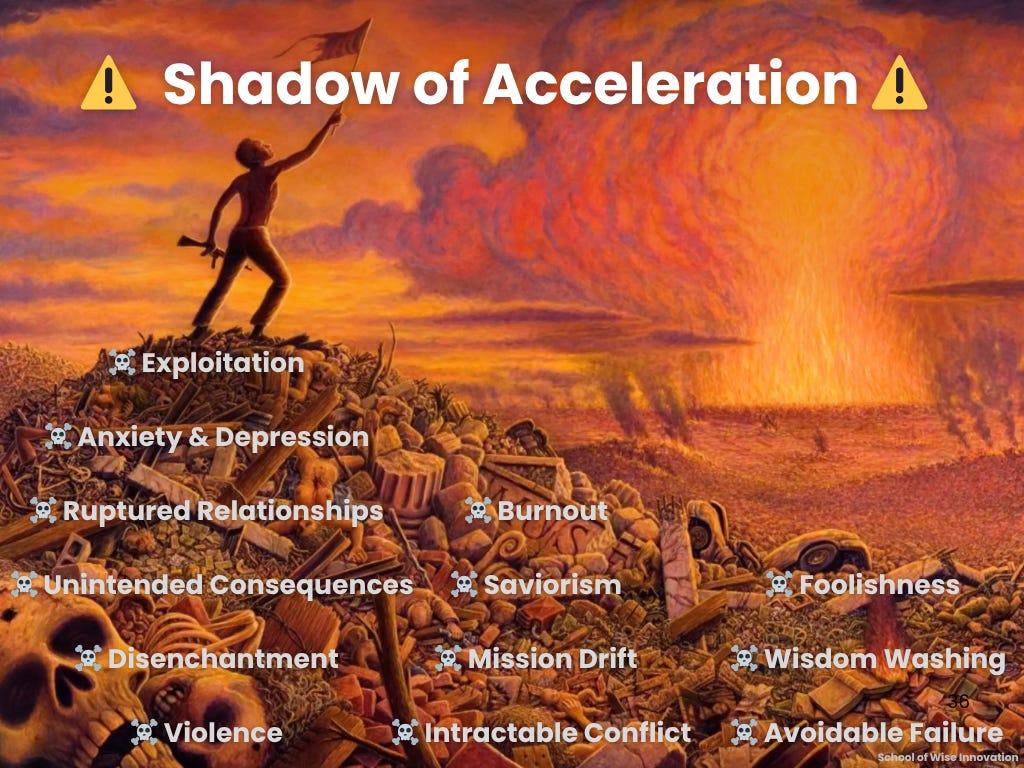
Acceleration is important at times, but acceleration only is foolish. Especially at the most delicate vision and early stages, when every choice and interaction has an outsized influence on what unfolds.
Speed and growth without integration, attunement, or relationship to the whole system can become destructive. Should leaders and teams working on the future of healthcare, technology, housing, bioregioning, movement building, childhood education, and spiritual community be accelerating all the time? Is it appropriate to have an accelerationist in the room with a new baby?
🐣 Incubate!
It’s worth touching on incubator too: a mechanical metaphor from the biomedical domain, suggesting a controlled, sterile environment separated from the outside world.
Similarly to startup accelerators, startup incubators tend to emphasize rapid prototyping, short-term metrics, and growth at all costs over being with emergence and tending the relational field.
While the word implies experimentation, there’s typically not a lot of room for a vision to take form outside the narrow interests of the incubator.
(Note: while the metaphor predominantly means one thing in startup culture, it can be also be used in reference to the living-systems activities in the womb. There certainly are some incubators embodying a more regenerative culture, like Design Science Studio who intentionally identify as an incubator, appreciating the metaphor of a container with certain conditions from which intentional thriving can occur.)
🛑 Decelerate!
In response to an acceleration-obsessed culture, a natural pendulum shift might be toward deceleration.
“People who have accelerated need to decelerate!”
“Projects must move only at the speed of trust and coherence!”
“We need to do EVERYTHING more slowly!”
These are valid arguments, and you’d be hard-pressed to find a bigger advocate for deceleration than me (been running decelerator retreats since 2021). I believe perpetually forward-moving initiatives have much to gain in slowing down or taking a pause. We’re going to need heaps of individual-focused programs like downshift to help individuals navigating transition.
But for supporting the manifestation of new projects into the world, I’ve come to believe that it’s not so much about slowing down all the time, but about right speed for right context.
Which sounds so obvious, but a level of nuance that mainstream culture doesn’t seem to hold. Duh, certain seasons or phases in the project’s life cycle may want acceleration, and others may want deceleration. Recently, downshift founder Steve Schlafman shared a realization that they had been defining ‘downshifting’ too narrowly – that it’s not about slowing down permanently, but cultivating the capacity to make momentary, periodic, or seasonal gear changes.
🌱 Cultivate!
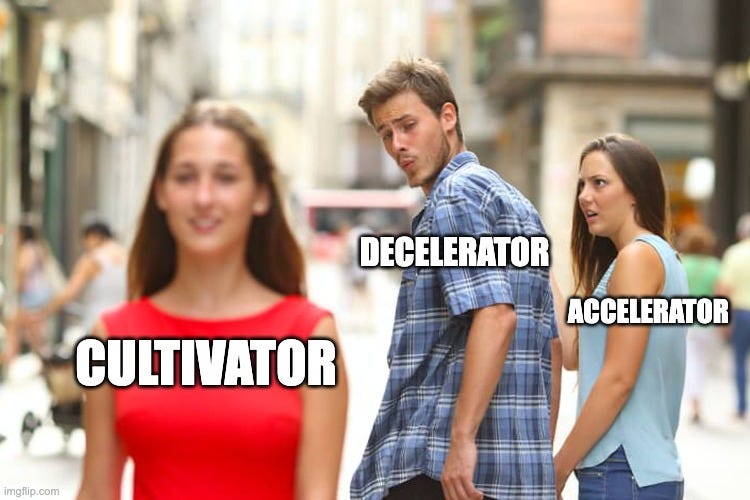
All of which is captured by the word Cultivator.
Cultivation is the act of preparing, caring for, and helping something grow — typically used in relation to land, plants, or capacities of the human spirit.
Cultivation represents nurturing conditions for healthy growth over time. It honors the organic rhythms of emergence, gestation, and integration. It implies stewardship rather than control.
A cultivator literally breaks up and loosens soil, removes weeds, aerates the ground, and prepares soil for planting. It helps improve soil conditions and support crop growth by creating a better environment for plant roots.
Core assumptions embedded in cultivation:
Life has its own pace and intelligence
Growth is cyclical, relational, and interdependent
Success is measured by health, wholeness, and contribution to the ecosystem
The role of the human is to tend, not to force
Cultivation encourages patience, resilience, and depth. Fosters sustainability and right relationship. And honors the invisible work of soil-building, not just the visible bounty of the harvest.

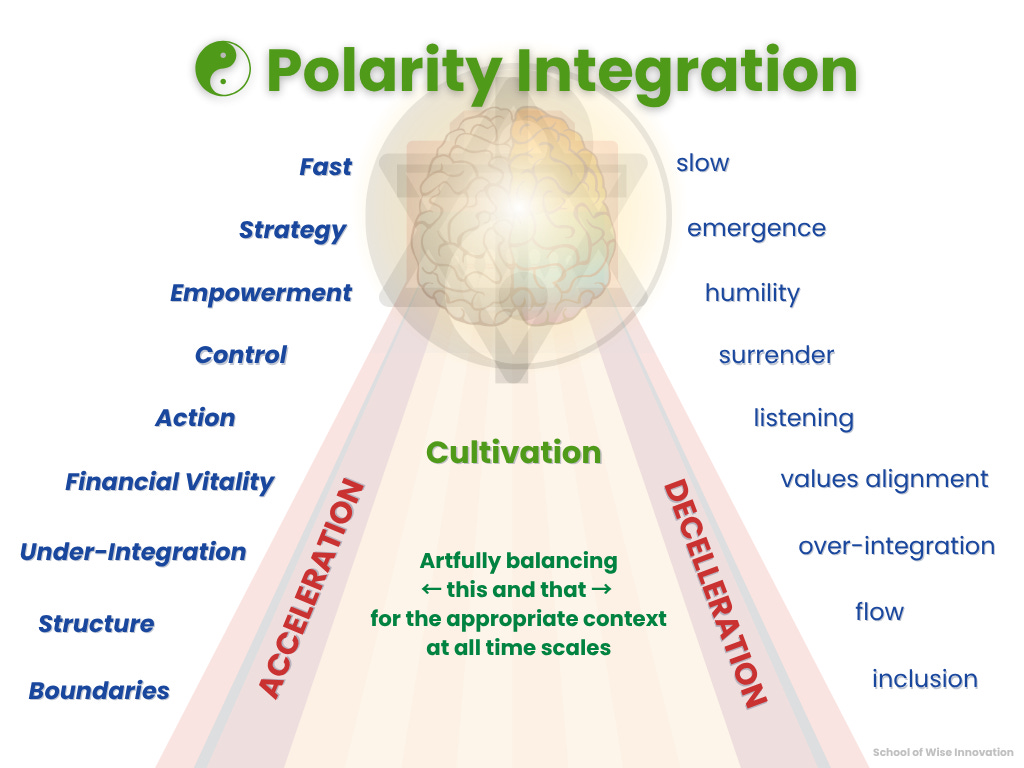
Cultivation is here for strategy, action, control and speed when appropriate. But only while grounded in emergence, listening, surrender and slowness.
Like every polarity, there is a healthy integration available, where the right energy is matched with the right context. The idea is to dance the line between the yin and yang, not be overly fixed in one or the other. And have a good balance amongst your organizational leadership. See also: Iain McGilchrist’s The Master and His Emissary on the brain’s right and left hemispheres.
In one of our Spring Cultivator sessions focused on “Right Relationship with AI,” friend of the school and Harvest Day judge Turquoise Sound spoke to this nuance:
“The discussion is: We’re driving off the cliff, do we drive all gas no brakes? Or all brakes no gas? I’ve been orienting to something like ‘move mindfully and maneuver well.’ No one drives all gas, no brakes. No one drives all brake, no gas. That doesn’t work. Both are wrong-headed, wrong orientations, wrong stories.”
🦋 Evolving Education & Enculturation
Beyond adopting a more appropriate name, how might cultivators look differently from accelerators in form?
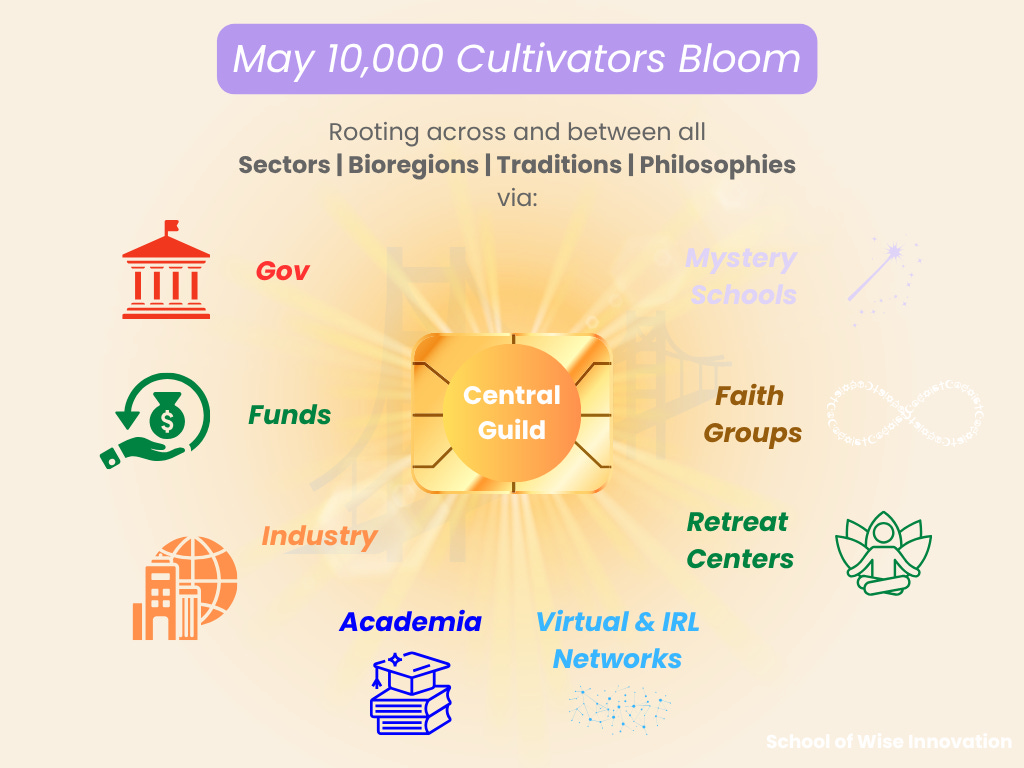
That’s a wide open question. In 🌱 May 10,000 Wisdom Schools for Innovators Bloom, we chose the number 10,000 because it’s the ChatGPT estimated number of business schools and startup accelerators in existence today.
We’re going to need an equivalent number to offset this imbalance of myopic containers — whether by building new schools and programs, or supporting existing ones to transform.
It’s a time for mass experimentation and learning from each other. Not only in what teachers and topics are brought in, but also in the hard problems of the structure of the cultivator itself — from financing and ownership to governance and organizational development. What does full-stack alignment look like for the containers supporting full-stack alignment of the people and projects participating in them?
Designing a cultivator program is an exquisite micro-fractal of designing a school because it forces key decisions on curriculum design, guiding philosophies, and structural incentives. The barrier to entry is fairly low–all it takes is some basic software tools, promotional energy, relationships with teachers and prospective students–but it takes a great deal of vision, care, rigor and maturity to do the cultivator name justice #ProcessIsProduct
Some of the more inspiring examples we are connected to that illustrate the range of emerging cultivator-like programming include JumpScale’s Resilience Circles, Sacred Leadership Co-Creation Cohort, Climate Wisdom Fellowship, True North Guild, Economy of Francesco Incubator, Embrace Community, Abundance House, Design Science Studio and Edge Finance Accelerator.
Every cultivator needs a cultivator.
There’s a paradoxical friction here: to create cultivators, we’re going to need entrepreneurs. But where will said entrepreneurs trained in the existing paradigm go to learn how to create in more holistic ways? What does it mean to be personally prepared to create a cultivator?
Similarly to how the visionary Krishnamurti believed that right education comes down to educating the educator as a whole person, perhaps what’s most needed is a meta-cultivator to cultivate healthy soil for cultivator founders and their visions to flower.
A training program to empower innovation education entrepreneurs, to learn and practice wise innovation, in the process of building new programs and schools capable of teaching it effectively.
Some colleagues and I have been discussing launching such a cosmo-local program (integrating universal principles with hyper-local context) that would blend ritual depth with operational rigor. Perhaps connected to a hackathon or micro-grant program. Get in touch if you are interested in supporting something like this.
Importantly, we do not wish to trash the virtues of accelerators, but leverage what’s healthy and compost what’s rotting — integrating their lessons and failures into fertile ground for wiser, more life-giving patterns of growth.
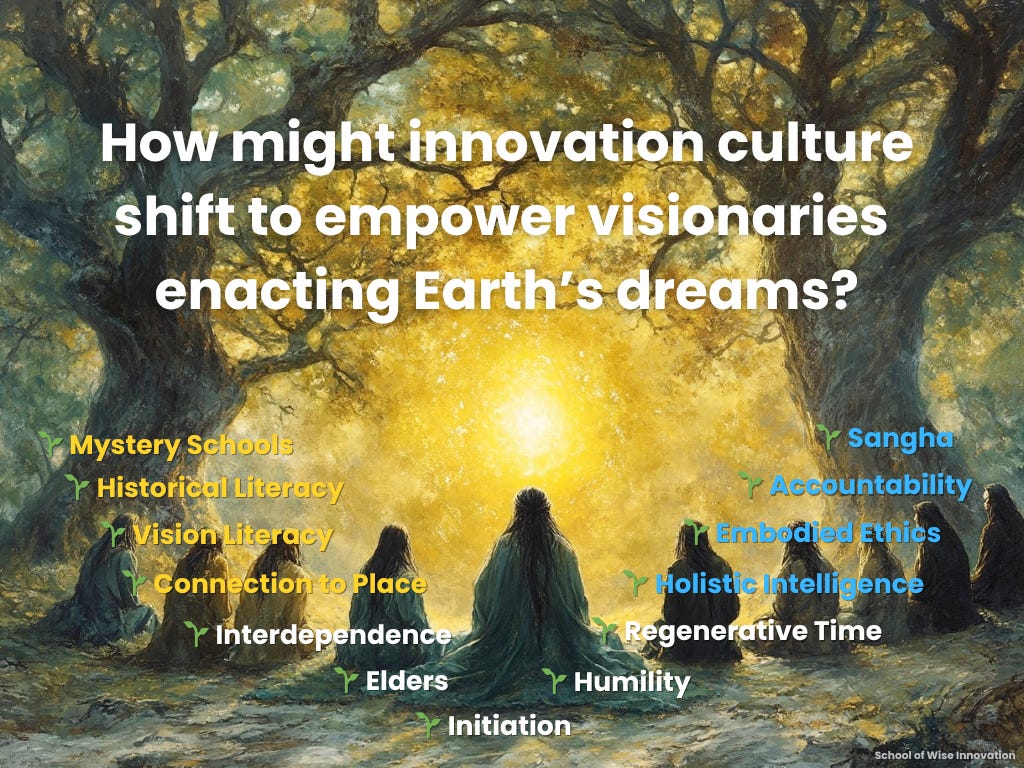
Can you imagine cultivators that begin with a vision quest? Regularly meet with an elder council? Integrate embodied ethics practices and regenerative time workflows?
What’s in your cultivator? Let us know in the comments!
Here are three short case studies from organizations that experimented with Cultivator programming this year:
BioFi Project
In January 2025, the BioFi Project (Bioregional Financing Facilities) began facilitating a learning, design, and capital raising journey with 22 bioregional organizing teams across the Americas.
Co-founder Samantha Power on choosing the name:
“Our choice of “Cultivator” instead of “Accelerator” is directly inspired by School of Wise Innovation and nRhythm. Both whom we appreciate for blending the value and critiques of “accelerators” and “decelerators.
At this urgent moment, we do see value in accelerating the growth of BFFs, however we simultaneously believe that for these institutions to grow in ecological and relational integrity in ways that strengthen antifragility to the further collapse, decoherence, destabilisation processes unfolding, we need to approach this work with an intentional pace that allows for careful cultivation rooted in strong relational development.”
Flourishing Systems Foundation
Our friends at FSF recently completed their inaugural Flourishing Cultivator: a 6-week program in collaboration with Grateful Giraffes for early stage startups across health and systems change. While experimenting with regenerative innovation processes, investment and legal models.
Founder Mingzhu He reporting on the philosophy and outcomes:
“The Flourishing Cultivator is structured like a living ecosystem, not a factory pipeline.
Like a flower bed or forest ecosystem, our work draws from living systems — because we are living systems, nested within larger ones. And like soil tenders, we hold the field together as a community — cultivating coherence through our relationships with one another.
We chose cultivator because it honors emergence and reciprocity—the tending of what wants to grow, rather than forcing outcomes. Flourishing requires moving at the speed of trust, not the pace of acceleration. Our goal is to grow deep roots in communities of practice that embody regeneration by design—restoring sacred connection between self, each other, nature, and cosmos.
We wove in frameworks from Daoist farming and regenerative finance to re-imagine innovation as an act of stewardship, not extraction. Mentors and wisdom keepers joined organically (some by design), sharing knowledge as part of the living field. The program became less about producing outputs and more about cultivating the conditions for life to thrive.
Even when founders realized that true alignment meant shifting direction away from venture creation or creating something entirely new, we saw that as success. Founders in the pilot began to see themselves not as startup CEOs, but as gardeners of systems. They discovered natural synergies, supported one another’s ventures, and even explored combining efforts. They reframed “traction” as flourishing indicators, “capital” as energy in flow, and “community” as core innovation infrastructure.”

School of Wise Innovation
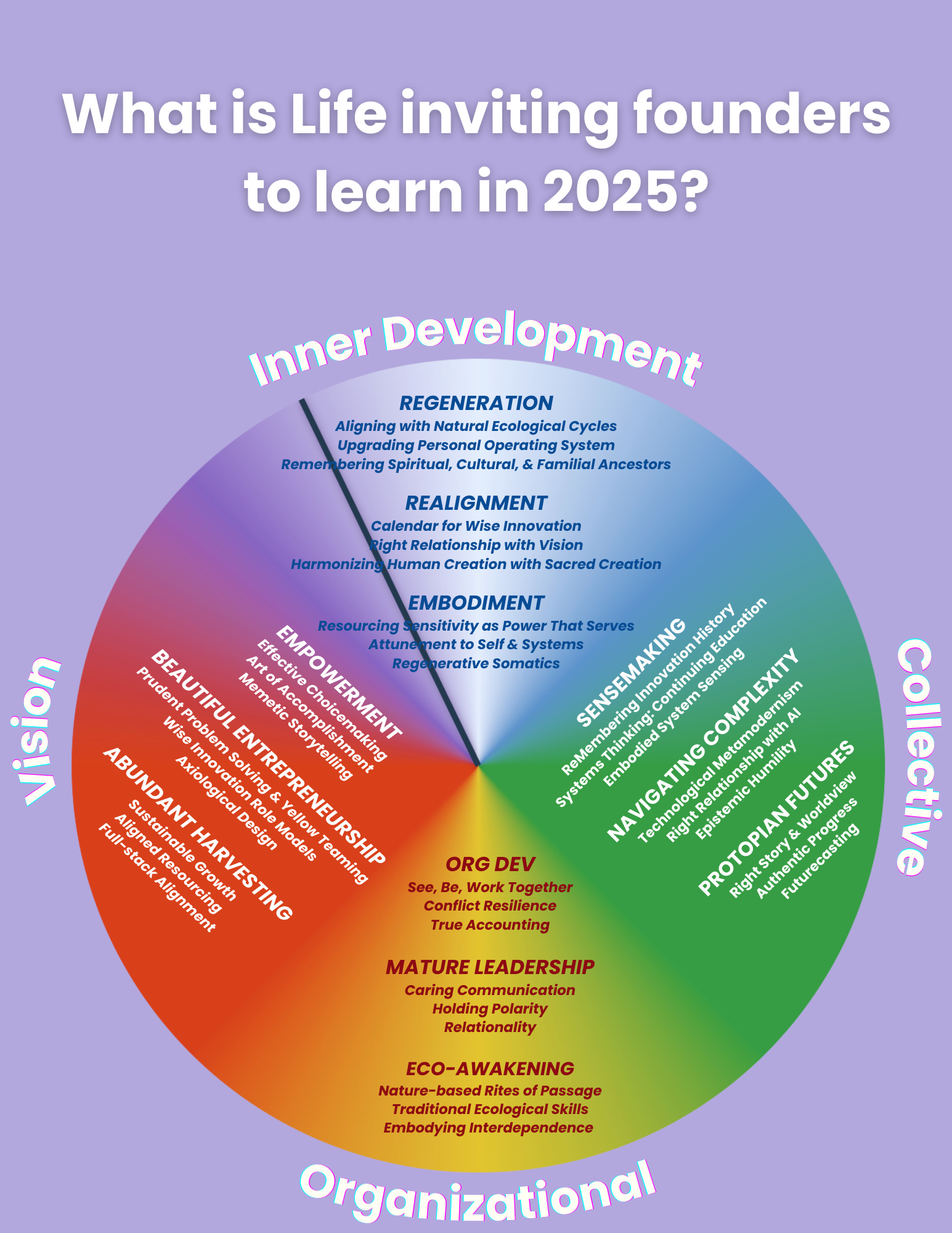
Last fall, while sensing into the coming solar cycle for School of Wise Innovation, we felt the ripening of a vision to re-imagine the accelerator into what we called the Vision Cultivator: a year-long exploration of a more holistic entrepreneurship curriculum, divided into four seasonal cohorts (we see aligning with natural ecological cycles as one of the core shifts for innovators to make):
❄️ Winter Cultivator on Inner Development
🌱 Spring Cultivator on Collective Wayfinding
☀️ Summer Cultivator on Organizational Development
We intend to share more of a full debrief and playbook soon. There’s lots to celebrate, from to record high tears of joy (our favorite KPI), to fresh insights around wise innovation, to endless relationships and collaborations sparked. And plenty of lessons learned around what it takes to design, market, and deliver a coherent, engaging, accessible and financially viable experience in this time between worlds.
In the spirit of cultivation, School of Wise Innovation doesn’t want to become a factory that just produces bigger and better cultivators each year. It’s more of an R&D lab, or experimental permaculture garden, in which we try innovative things, bring good people together, and share stories outwards. So while we’ve had a good harvest with this central crop, we’re not necessarily going to sow the exact seed again next year.
⛰️ The Cultivator Challenge
Dear accelerators with intentions for impact and social responsibility, ethics and alignment, regeneration and sacredness; who want to create something new, but not if it involves reproducing the same shitty dynamics that created the metacrisis:
We invite your courage and creativity in trying new things, your humility and discomfort in unlearning old ways, your commitment into living into questions around right relationship across all aspects of your life and work.
We challenge you not only to change your name from “accelerator” to “cultivator,” but to go on a learning journey to reconsider the full-stack: financing, ownership, governance, product design, org culture, and how you live your lives.
Because “cultivator” isn’t just a rebrand — it’s a structural and cultural realignment. We’re not just swapping syllables — we’re swapping worldviews and practices. It’s hard but extremely rich work. And we need each other to see it through.
A group of us who have been staring at this puzzle for years is in the early stages of creating criteria by which cultivators might be evaluated, and accountability processes for calling in folks who are missing the mark. We don’t wish to wisdom police, but we care about the health of the emerging ecosystem, and will do what we can to mitigate the risk and impact of wisdom washing.
In the meantime, School of Wise Innovation and friends are working with several organizations on their program design, and would be happy to partner with you to support your accelerator transformation or cultivator creation.
In the interest of tracking and gathering the cultivators, please let us know if you have seen any others in the wild, or are in the process of changing yours!
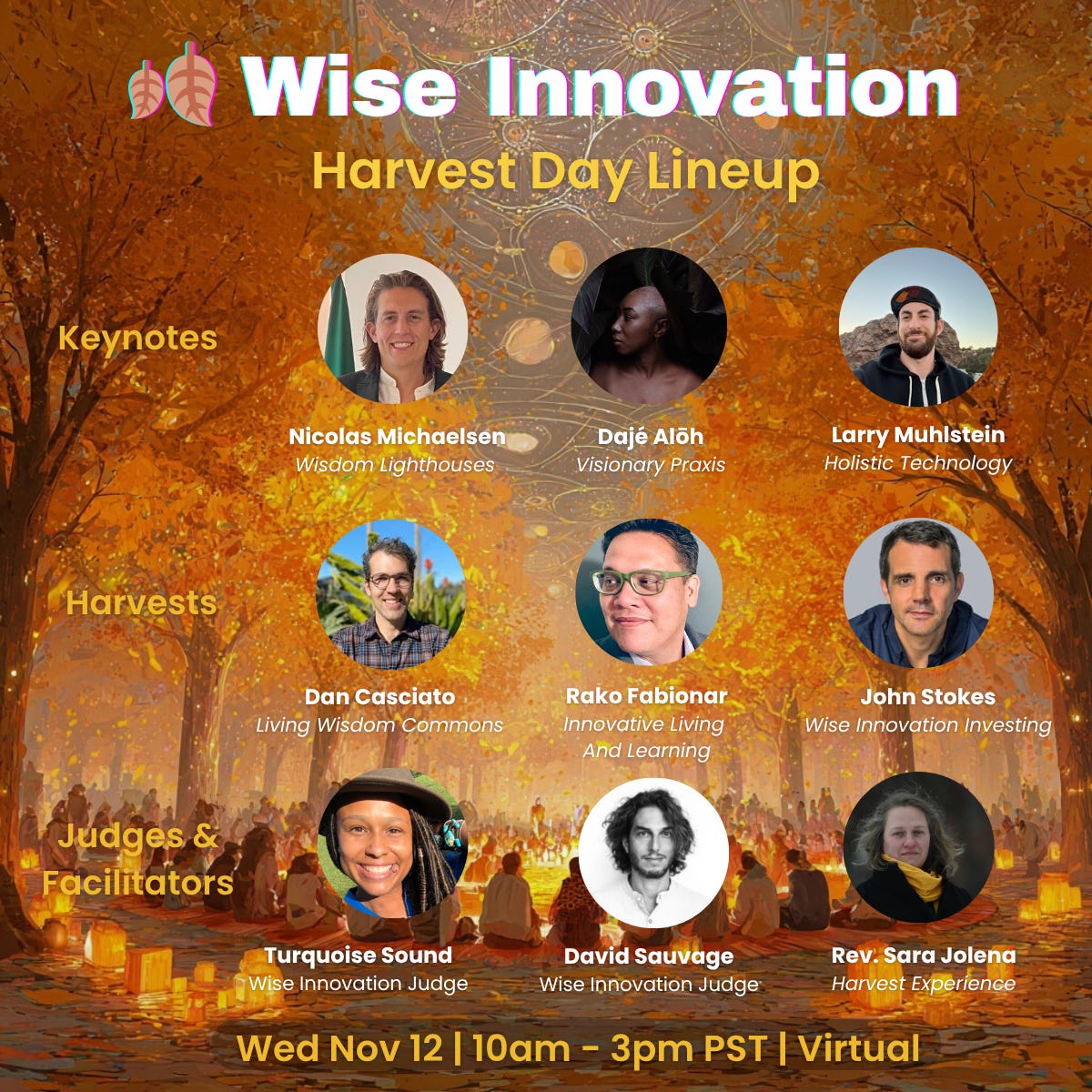
🍂 Taste a Cultivator on Wed Nov 12
In our continuing efforts to re-imagine innovation education, we’re taking a stab at the accelerator demo day as a half-day virtual event.
Instead of the usual homogenized, flattened, rapid-fire, anxious pitches on the latest frothy, market-driven, change-the-world thing...
We’re curious what happens when we gather with ritual and embodiment: listening to authentic storytelling around pivotal moments of awe and challenge, instructive examples of deeply aligned entrepreneurship, and hard earned wisdom on what’s required to enact vision with integrity.
Join us in celebrating and showcasing the harvests of several of the brightest lights in our orbit: philosophers, investors, builders and visionary artisans of culture.
You can stop by for as little or as long as you’d like. We guarantee you will leave inspired.
May the age of accelerators give way to an era of cultivators — where innovation once again serves life.
With great gratitude,
Andrew Dunn
School of Wise Innovation
💌 Please consider sharing this Substack post with folks you know involved with accelerators or incubator programs!